About Us

Ayushman Bharat Digital Mission

Image
About ABDM

The Ayushman Bharat Digital Mission (ABDM) in Uttar Pradesh aims to build the backbone of the state’s integrated digital health infrastructure. By leveraging digital highways, it will bridge existing gaps among stakeholders in the healthcare ecosystem, including government hospitals, private clinics, diagnostic centers, and insurance providers across the state. In Uttar Pradesh, ABDM will create a seamless online platform by providing a wide range of data, information, and infrastructure services. These services will be based on open, interoperable, and standards-driven digital systems, enabling efficient healthcare delivery for both urban and rural populations.


The National Health Policy (NHP) 2017 has the following goals:
“The attainment of the highest possible level of health and wellbeing for all at all ages, through a preventive and promotive health care orientation in all developmental policies, and universal access to good quality health care services without anyone having to face financial hardship as a consequence.”
In a follow-up of the NHP’s specific goals for adopting digital technologies, the Ministry of Health and Family Welfare constituted a committee headed by Shri J. Satyanarayana to develop an implementation framework for the National Health Stack. This committee produced the National Digital Health Blueprint (NDHB), laying out the building blocks and an action plan to comprehensively and holistically implement digital health.
Taking forward the NDHB, this document describes the broad context, rationale, scope, and implementation arrangements for a digital ecosystem for healthcare services across the country. Since the implementation is envisioned to be in a mission mode, the initiative is referred to as the Ayushman Bharat Digital Mission (ABDM).
2017 India’s National Health Policy
2018 Release of National Health Stack (NHS) by NITI Aayog
2019 National Digital Health Blueprint (NDHB)
introduced which is based on IndEA architecture of Digital India
2020 Launch as NDHM in 6 Union territories on 15th August 2020 by Hon PM
2021 Later in entire nation on 27th September 2021, with the name of ABDM

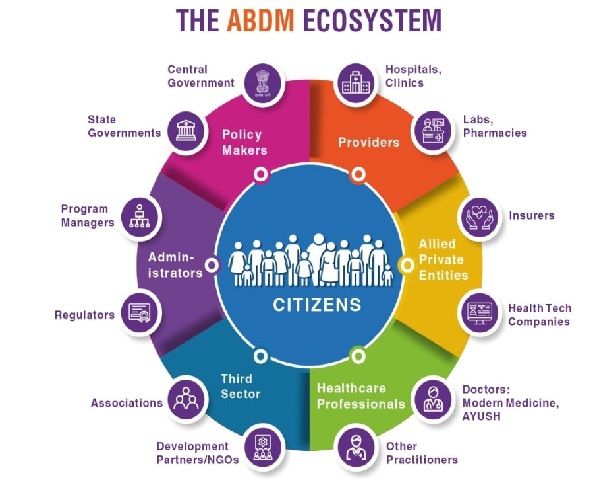
Stakeholders & their Roles

NHA
    The National Health Authority (NHA) plays the central role of designing, executing, and monitoring the ABDM (Ayushman Bharat Digital Mission) framework across the country. It provides overall guidance and policy direction, ensures financial resourcing, and offers technical expertise to states and stakeholders. NHA is also responsible for building capacity through training, setting standards for digital health, and offering support to ensure smooth adoption of ABDM-enabled solutions.
Implementation Agency
Government Bodies
    State governments and health departments act as the implementing authorities at the state level. Their responsibilities include ensuring compliance with ABDM frameworks, coordinating across departments, regulating and monitoring the system, and managing funds for digital health adoption. They also play a critical role in awareness campaigns, training health professionals, and collaborating with public and private health partners to enable seamless ABDM adoption at the ground level.
State Health Department
Healthcare Providers
    Healthcare providers are the operational backbone of ABDM adoption as they directly interact with patients. Their responsibilities include registering facilities and professionals in HFR (Health Facility Registry) and HPR (Healthcare Professionals Registry), adopting ABDM-compliant systems such as HMIS, and ensuring proper patient data management. They are also responsible for the capacity building of their staff to effectively use digital tools, thereby ensuring that health services are more efficient, transparent, and interoperable
Hospitals, Clinics, Labs, Pharmacy etc
Patients / Citizens
    Patients and citizens are at the core of ABDM as end beneficiaries. Their role is to adopt and register for a Digital Health ID, actively link their health records with providers through the ABDM ecosystem, and utilize digital health services like telemedicine. They are also expected to participate in the ecosystem by consenting to share and access digital health records, scanning QR codes for services, and making use of digital platforms for improved healthcare access and continuity.
Beneficiaries
Digital Solution Company
    Technology vendors and IT providers are enablers of the ABDM ecosystem, responsible for developing interoperable and ABDM-compliant solutions. They ensure data security, privacy, and provide technical support for integration with ABDM platforms. Their role extends to innovating new solutions, such as AI-based diagnostics and telemedicine platforms, to support healthcare providers and improve patient outcomes. By building robust, secure, and user-friendly digital health infrastructure, they bridge the gap between policy frameworks and real-world adoption.
Technology Vendors and IT Providers